Lomonosov
Philology
Journal
ISSN 0130-0075
ABOUT US
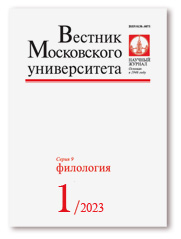
The journal was founded in 1946. Before 1959, it was part of the History and Philology series, later — the Philology and Journalism Bulletin. Since 1965, it has been a standalone series of Moscow University Bulletin, labelled Series 10. Philology before 1976 and Series 9. Philology from 1976 to the present day.
It is one of Russia’s leading periodicals in philology. Publications include articles, submissions and reports, reviews and bibliographical surveys, reports on conferences and round-table discussions within the journal’s scope.
Publication frequency: six times a year; size of each issue: 15 print sheets (240 pages).
The journal is on the List of peer-reviewed academic journals recommended by the Higher Attestation Commission (VAK) that publish key findings of dissertations submitted for the degrees of PhD and Dr.Habil. in philology in the following fields:
10.01.01 — Russian literature, 10.01.02 — Literatures of the peoples of the Russian Federation (indicating the specific literature(s)), 10.01.03 — Foreign literatures (indicating the specific literature), 10.01.08 — Theory of literature. Textual criticism, 10.01.09 — Folklore studies, 10.02.01 — Russian language, 10.02.02 — Languages of the peoples of the Russian Federation (indicating the specific language or language family), 10.02.03 — Slavic languages, 10.02.04 — Germanic languages, 10.02.05 — Romance languages, 10.02.14 — Classical, Byzantine and modern Greek philology, 10.02.19 — Theory of language, 10.02.20 — Comparative, typological and contrastive linguistics, 10.02.21 — Applied and computational linguistics, 10.02.22 — Foreign languages: Europe, Asia, Africa, indigenous languages of the Americas and Australia (indicating the specific language or language family).
The journal is indexed in the Web of Science via RSCI, and included in the system of Russian Science Citation Index (RSCI).
It is indexed by the international information systems Brill, De Gruyter Saur, EBSCOhost, ERIH PLUS, Gale, ProQuest.
Full-text copy of the journal is available online on the e-Library web site. Subscription is required for publications of the current and previous year, open access is granted to those of the preceding years.
Reference to the journal is required in case of republication.
Ethical standards
The Editorial Board of the journal Moscow University Philology Bulletin is guided in its operations by the Russian law on copyright and plagiarism, as well as ethical standards and principles accepted by the international community, including those set out in the Code of Conduct and Best Practice Guidelines for Journal Editors and Code of Conduct for Journal Publishers developed by the Committee on Publication Ethics (COPE).
The Editorial Board maintains confidentiality of the personal data and research findings related to the contributions. In the peer review process, the Editorial Board undertakes to prevent conflict of interest and to be guided solely by the criteria of originality, significance and relevance of the research. Moscow University Philology Bulletin is a discussion platform primarily concerned with mainstream trends in Russian and international philological research. We welcome critical reviews of the journal’s publications, contributions over the last ten years representing the schools of thought of the Faculty of Philology, leading linguists and literature researchers of Moscow University.
Only new, previously unpublished contributions are accepted for consideration. The authors should comply with the ethical standards and research regulations. By submitting a manuscript, the authors confirm that it is authentic and independent, no copyright of other natural or legal persons was infringed.
EDITORIAL BOARD
Editor in Chief
Prof. Marina Remneva, Dr.Habil., Head of the Russian Language Department, President of the Faculty of Philology, Lomonosov Moscow State University
Deputy Editor in Chief for Linguistics
Prof. Irina Kobozeva, Dr.Habil., Theoretical and Applied Linguistics Department, Faculty of Philology, Lomonosov Moscow State University
Deputy Editor in Chief for Literature Studies
Prof. Vasily Tolmachev, Dr.Habil., Head of the Department of the History of Foreign Literatures, Faculty of Philology, Lomonosov Moscow State University
Assistant Editor for Linguistics
Prof. Elena Razlogova, Dr.Habil., Department of French Linguistics, Faculty of Philology, Lomonosov Moscow State University
Assistant Editor for Literature Studies
Prof. Galina Zykova, Dr.Habil., Department of the History of Modern Russian Literature and the Current Literary Process, Faculty of Philology, Lomonosov Moscow State University
Organising Secretary
Assoc. Prof. Ekaterina Belavina, PhD, Department of French Linguistics, Faculty of Philology, Lomonosov Moscow State University
Editorial Board members:
Prof. Olga Alexandrova, Dr.Habil., Head of the English Linguistics Department, Deputy Dean for Research, Faculty of Philology, Lomonosov Moscow State University
Assoc. Prof. Alexey Belikov, PhD, Department of Classical Philology, President of the Young Researchers’ Council, Faculty of Philology, Lomonosov Moscow State University
Prof. Tatiana Venediktova, Dr.Habil., Head of the Department of Discourse and Communication Studies, Faculty of Philology, Lomonosov Moscow State University
Prof. Dmitry Ivinsky, Dr.Habil., Department of the History of Russian Literature, Faculty of Philology, Lomonosov Moscow State University
Prof. Andrey Izotov, Dr.Habil., Slavic Philology Department, Faculty of Philology, Lomonosov Moscow State University
Assoc. Prof. Vladimir Korovin, Dr.Habil., Department of the History of Russian Literature, Faculty of Philology, Lomonosov Moscow State University
Prof. Natalia Pakhsaryan, Dr.Habil., Department of the History of Foreign Literatures, Faculty of Philology, Lomonosov Moscow State University
Prof. Elena Petrukhina, Dr.Habil., Russian Language Department, Faculty of Philology, Lomonosov Moscow State University
Prof. Alexey Solopov, Dr.Habil., Head of the Classical Philology Department, Faculty of Philology, Lomonosov Moscow State University
Prof. Sergey Tatevosov, Dr.Habil., Head of the Theoretical and Applied Linguistics Department, Faculty of Philology, Lomonosov Moscow State University
INTERNATIONAL EDITORIAL BOARD
Prof. Antonella Amatuzzi, PhD (Italy, University of Turin)
Prof. Jean-Louis Backès (Université de Paris IV , France)
Prof. Alexander Verlinsky, Dr.Habil (Russia, Saint Petersburg State University)
Prof. Valery Demyankov, Dr.Habil (Russia, Institute of Linguistics of the Russian Academy of Sciences)
Prof. Olga Inkova-Manzotti, Dr.Habil (Switzerland, University of Geneva)
Prof. Vadim Polonsky, Dr.Habil (Russia, Institute of World Literature of the Russian Academy of Sciences)
Prof. Ivan Rovdo, Dr.Habil (Belarusian State University, Faculty of Philology)
Prof. Vyacheslav Terkulov, PhD (DNR, Donetsk National University)
Assoc. Prof. Mladen Uhlik, PhD (Slovenia, University of Ljubljana)
FOR OUR CONTRIBUTORS
Contributions can be made in Russian or English.
All the contributions proposed for publication are to be sent by e-mail: edit@philol.msu.ru or submitted to the Editorial Board on a CD (and, optionally, as a hard copy); a manuscript can also be sent to the Editorial Board by regular mail.
Only the manuscripts complying with the Formatting guidelines for the articles submitted to the Editorial Board of Moscow University Philology Bulletin are accepted for review, otherwise the contributions remain unaddressed.
Formatting samples:
Manuscript formatting sample for the Articles section (in Russian)
Manuscript formatting sample for the Articles section (in English)
Manuscript formatting sample for the Reviews section
Manuscript formatting sample for the Academic Life section
Manuscript formatting sample for the Anniversaries section
Manuscript formatting sample for the In Memoriam section
Formatting guide:
— Contributions should be submitted as *.doc, *.docx or *.rtf files.
— Contributions should have the following maximum length (characters with spaces plus the number of paragraphs, including data in Russian and English, reference lists and information about the author(s)) by section: Articles:
—
— All additional fonts, charts and figures (only as *.tiff) should be sent as separate files. Fonts are to be embedded in the PDF files.
Review process:
Regulations on the procedure for reviewing manuscripts submitted for publication in the Lomonosov Philology Journal (approved at the meeting of the Academic Council of the Faculty of Philology of Lomonosov Moscow State University, Protocol No. 11 dated November 21, 2024).
1. All submitted materials are reviewed by experts in the relevant field within the procedure of single-blind peer review. All final decisions regarding the rejection of a manuscript or its acceptance for publication are made by the editorial board of the journal.
2. The manuscript may be rejected before being reviewed by the responsible secretaries for linguistics and literary criticism due to inconsistencies in the content of the article with the subject of the journal and due to non-compliance with the requirements for volume and design. If the manuscript meets the requirements for content, volume and design, it is accepted for further consideration. One of these solutions is approved at an editorial board meeting and communicated to the author in writing by the secretary of the journal within two months of receipt of the manuscript. In case of a decision on further review, reviewers are appointed within a week.
3. Within 45 days, the reviewers prepare 1) a reasoned rejection of the manuscript; 2) a conclusion on the possibility of publishing the manuscript without revision; 3) recommendations for publication after further revision. These decisions are made or rejected at the next meeting of the editorial board after the review is completed, and are communicated to the author(s) by the secretary within one week after the specified meeting of the editorial board.
4. If the editorial board decides on the possibility of publishing the manuscript after its revision, the comments and recommendations of the reviewers are sent to the author(s), according to paragraph 3, within one week after the editorial board meeting by the executive secretary. The author may agree or disagree with the opinion of the reviewers and, accordingly, make corrections or provide a reasoned refusal to make corrections.
5. The results of the examination are reviewed at the next meeting of the editorial board, which makes a reasoned conclusion on the possibility of publishing the text without making changes, on the impossibility of its publication or on the need for further work on the text. In this latter case, the procedure specified in paragraph 4 is reiterated.
6. Based on the results of the repeated discussion of the article, the editorial board makes a reasoned decision on the possibility or impossibility of publishing the text, which is communicated to the author(s) by the secretary within one week after the editorial board meeting. The secretary sends the author(s) the publishing agreement.
7. If the editorial board makes a positive decision, the manuscript will be published within one year from the date of the decision.
8. In case of a positive decision of the editorial board to publish the material, the author(s) must submit a signed copy of the consent to the processing of personal data (for each author separately) and the offer (uniform for all co-authors) in scanned form to the editorial office’s e-mail address (journal@msupress.com and edit@philol.msu.ru), as well as send the originals of the specified documents at the address: Russia, 119991, Moscow, GSP-1, Leninskie Gory, 1, building 51, Lomonosov Moscow State University, Faculty of Philology, room 902. The forms of the offer and consent to the processing of personal data are posted on the official website of the journal on the Internet.
The inclusion of the material in the content of the current issue is carried out by the editorial board only if there is an offer and consent to the processing of personal data in the editorial office.
9. The authors are not charged for publication. The fee is not paid. The editorial board does not deliver or distribute printed copies.
10. The Editorial Board accepts for consideration only new, previously unpublished materials. The authors are to comply with ethical standards and rules of academic research. By submitting the material, the authors confirm its originality and independence, and the absence of copyright violations by other individuals and legal entities. All materials are checked through the “Antiplagiat” system. By sending the material to the editorial office, the author also declares that there is no conflict of interest.
CONTENTS
Contents, abstracts and key words of the articles published in the past two years
2022
2021
FULLTEXT ISSUES
2020
2019
2018
2017
2016
2015
2014
2013
CONTACTS
Lomonosov Moscow State University, Faculty of Philology, Room 902; 1 Leninskie Gory Bldg. 51, Moscow, 119899, Russia
Phone: +7-495-939-53-80
E-mail: edit@philol.msu.ru
Organising Secretary: Ekaterina Belavina